





IDF thwarts massive rocket barrages planned by Hezbollah, continues pounding terror targets across Lebanon
Ground troops dismantle 80 Hezbollah sites in southern Lebanon
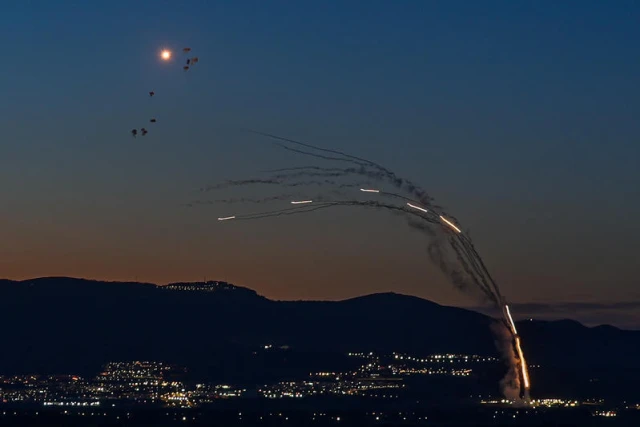
The Israel Defense Forces thwarted most of a planned large-scale Hezbollah rocket attack on Tuesday evening after issuing advance warnings to northern Israeli communities.
Nevertheless, the terror group launched around 40 rockets, one of which damaged a house in the city of Karmiel without causing injuries. The IDF said it had “identified early preparations and initiated a wave of strikes to disrupt” the attack.
“This included preventative strikes on launchers, weapons storage sites and operational command centers. With the beginning of the Hezbollah attacks, the IDF rapidly identified and struck launchers and terrorist operatives that had fired the projectiles. Combined, these efforts reduced the scope of fire towards Israel.”
In response, the IDF issued a notice urging residents of the city of Tyre to distance themselves from Hezbollah sites, before airstrikes hit “weapon storage sites and operational outputs that had been deliberately embedded within the civilian population in Tyre, reiterating the terrorist organization’s systematic abuse of the Lebanese population as human shields.”
The IDF says it thwarted more than half of a planned Hezbollah rocket barrage on northern Israel, with the group intending to launch around 100 rockets but managing to fire about 40 along with missiles and five drones. Most were intercepted or landed in open areas, though one… pic.twitter.com/3JEM7YOJuQ
— ILTV Israel News (@ILTVNews) March 18, 2026
Other strikes hit Hezbollah-affiliated gas stations and targets belonging to the Al-Qard al-Hasan Association, Hezbollah’s financial arm.
“The organization is used to fund its military buildup, support terrorist payroll, and advance terrorist activities. The Israeli Air Force and the Israeli Navy also targeted Imam Hussein Division command centers in southern Lebanon. The Israeli Navy also targeted Hezbollah terrorists in Beirut,“ the IDF reported in its statement.
Military officials told news outlets that Hezbollah had planned to launch about 100 rockets simultaneously. The terror group called the plan “Operation Khaybar 1,” referring to an ancient Quranic battle where the Prophet Mohammed slaughtered the Jewish residents of the eponymous town.
⭕️ In the past hour, the IDF struck launchers and Hezbollah terrorists throughout Lebanon.
— LTC Nadav Shoshani (@LTC_Shoshani) March 17, 2026
Rocket launching cells and launchers are struck prior to, or immediately following, a launch. https://t.co/GAywNxRrO1 pic.twitter.com/2OqHKv8eaE
IDF officials added that Hezbollah has dispersed its launchers across a wide range of locations, making them harder to detect and still has thousands of short-range rockets. Most of its strategic arsenal, including long-range and precision missiles, has been destroyed by the Israeli forces over the past few years.
Meanwhile, the IDF has released limited information about its ground operations in southern Lebanon, particularly regarding troop locations, which could indicate how deep forces have advanced into the country.
The military said it has steadily increased the number of troops deployed in the area. On Tuesday morning, the IDF said forces under the 146th Division had dismantled more than 80 Hezbollah infrastructure sites over the past week and "struck and eliminated two operatives who emerged from a site in the area."
An Israeli security source told Sky News Arabia that the military operation in southern Lebanon would continue – if necessary – until the summer, adding that the IDF is creating a buffer zone there.
It remains unclear whether Israel plans to hold this zone for a prolonged period of time or to withdraw once it has been cleared of Hezbollah infrastructure, as it did in late 2024, although in a much smaller area.
The Lebanese Ministry of Health reported that more than 900 people have been killed and over 2,200 injured since Hezbollah reignited the war by attacking Israel to support the Iranian regime. The Health Ministry data does not differentiate between terrorists and civilians.
European leaders and the United Nations have sharply criticized Israel’s actions in Lebanon.
UN Human Rights Office spokesman, Thameen Al-Kheetan, cited data from the Norwegian Refugee Council indicating that Israeli evacuation orders now covered some 14% of Lebanese territory.
This means that “almost 20 percent” of the country’s 5.8 million residents are currently displaced, he said.
On Monday, Canada, France, Germany, Italy and Great Britain warned in a joint statement that “a significant Israeli ground offensive” must be averted due to its potentially devastating humanitarian consequences.
"We are gravely concerned by the escalating violence in Lebanon and call for meaningful engagement by Israeli and Lebanese representatives to negotiate a sustainable political solution," the countries said.
On Tuesday, French President Emmanuel Macron's special envoy to Lebanon, Jean-Yves Le Drian, reiterated that “the only solution to end the conflict in Lebanon lies in negotiation,” according to Reuters.
“Israel has not succeeded in disarming Hezbollah, so it cannot expect the Lebanese government to do so in three days under bombardment,” he said.

The All Israel News Staff is a team of journalists in Israel.
You might also like to read this: