





Hezbollah signals it will not enter war unless US strikes Iranian leadership

A Hezbollah official said Wednesday that the Iranian-backed militia would stay out of any “limited” U.S. military action against Iran but warned it would intervene if Washington sought to topple the regime or target the country’s supreme leader.
“In the event of limited US strikes on Iran, Hezbollah’s position will be to not intervene militarily,” the official told Agence France-Presse (AFP) on condition of anonymity.
The Trump administration has reportedly considered striking targets within Iran’s ayatollah-led regime, including Supreme Leader Ali Khamenei. The Hezbollah official predicted that if Washington decides to strike the ayatollah regime, the United States' ally Israel would “inevitably wage a war against Lebanon.”
The Hezbollah official's comments signal that the terror group prefers to avoid a military confrontation with the U.S. and Israel while stressing that an attack on the ayatollah regime would be considered a “red line.”
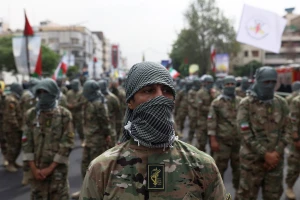
Hezbollah is widely seen as Tehran’s most powerful terrorist proxy in the region and has also established terrorist cells worldwide, including Africa, Europe, and the Americas. However, Hezbollah is severely weakened after Israel degraded much of the terror militia’s military capabilities, including its once vast missile arsenal that was financed and built by Iran. In 2024, the Israeli military and intelligence agencies killed thousands of Hezbollah operatives and decapitated the group’s top leadership, including the elimination of its top leader, Hassan Nasrallah.
Hezbollah’s current leader, Naim Qassem, who lacks the charisma and leadership skills of his predecessor Nasrallah, has argued that Hezbollah is currently in a “defensive position” but warned that it would consider itself “targeted” if the U.S. or Israel strikes its Iranian patron.
Arab media outlets reported earlier this week that officers from Iran’s elite Islamic Revolutionary Guard Corps (IRGC) have assumed command of Hezbollah forces in Lebanon amid growing tensions between the ayatollah regime and the United States. While Hezbollah has traditionally followed its Iranian patron’s orders, the reported IRGC takeover suggests Tehran no longer trusts its proxy to carry out a potential order to strike Israel.
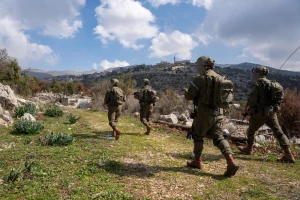
Despite a formal ceasefire, there are growing tensions between Hezbollah and Israel. Hezbollah actively seeks to rebuild its degraded military force, while Israel has targeted Hezbollah military assets and thereby signaled that it will not tolerate a Hezbollah buildup. The ceasefire stipulates that Hezbollah must withdraw its forces from southern Lebanon and disarm. However, the terrorist militia has so far refused to disarm and continues to play an influential role in Lebanese society.
Many Lebanese are concerned that Hezbollah will once again drag the country into a military conflict with Israel.
“What the Lebanese fear is a chain reaction: an American strike against Iran, a Hezbollah retaliatory strike against Israel, followed by a massive Israeli response,” a Lebanese official said on condition of anonymity.
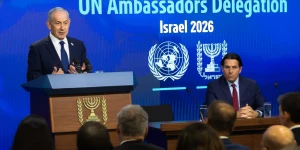
Reuters reported earlier this week that Israel has warned the Lebanese government that it would launch significant military strikes on Lebanon if Hezbollah were to attack Israel during a military confrontation between the U.S. and Iran.
Lebanese Prime Minister Nawaf Salam argued that Beirut has “no control over the course of Iranian-American relations.” He also urged Hezbollah to avoid provoking a massive Israeli military response.
“The Gaza adventure came at a high cost to Lebanon, and we hope we will not be dragged into another one,” Salam assessed.
“There are signs that the Israelis could strike very hard in the event of an escalation, potentially including strategic infrastructure such as the airport,” Lebanon’s Foreign Minister Youssef Raggi warned on Tuesday in Geneva, where the U.S. and Iran are conducting negotiations aimed at finding a diplomatic solution to the conflict.

The All Israel News Staff is a team of journalists in Israel.
You might also like to read this: